Is My Job Safe From AI? How to Assess the Real Risk
A practical way to judge how exposed your job is to AI, what tasks are vulnerable, and how to make yourself harder to replace.
Deelo Editorial
If you’re asking "is my job safe from ai," the honest answer is: probably not completely, but that does not mean your whole role disappears soon. AI is more likely to change jobs task by task than erase entire occupations at once, and your risk depends less on your title than on the kind of work you actually do all day.
That distinction matters. Two people with the same job title can face very different levels of exposure if one spends most of the week on repeatable digital tasks and the other spends it on judgment, client trust, coordination, or hands-on work in messy real-world settings.
The short answer: jobs are bundles of tasks
The most useful way to think about AI and work is this: jobs are bundles of tasks, not single units. AI can be very good at some tasks inside a role and weak at others.
For example, a marketer may use AI to draft copy variations, summarize competitor research, or organize campaign ideas. That does not automatically mean the company no longer needs marketers. It may mean the company needs fewer hours spent on first drafts and more value from strategy, brand judgment, channel selection, and performance analysis.
The same pattern shows up across many fields:
- Customer support includes answering routine questions, calming upset people, spotting edge cases, and knowing when to escalate.
- Legal work includes document review, research, client counseling, negotiation, and risk judgment.
- Software work includes writing boilerplate code, debugging, understanding business needs, reviewing architecture, and managing tradeoffs.
- Administrative work includes scheduling, document handling, follow-ups, exception management, and interpersonal coordination.
AI tends to fit best where the task is digital, frequent, structured, and judged by patterns in past examples. It tends to fit worse where the work depends on accountability, physical presence, unclear goals, or relationships that people are not ready to hand over.
So the right question is not "Will AI replace my profession?" It is: "Which parts of my work can AI do well enough that an employer might redesign my role around it?"
What makes a job more exposed to AI
Some kinds of work are easier to automate or reduce with AI assistance than others. Risk generally rises when your core tasks have several of these traits:
1. The work is mostly text, image, audio, or data processing
If most of your output lives on a screen and follows recognizable patterns, AI has more room to help or compete. Drafting routine emails, summarizing documents, tagging content, creating first-pass reports, and answering predictable questions all fit here.
That does not mean the work becomes worthless. It means the market may start valuing speed and oversight differently. Employers may expect one person to handle a larger volume with AI support.
2. The task is repetitive and the rules are fairly stable
AI struggles less when the task looks similar each time. Standard product descriptions, common support replies, meeting summaries, and structured research briefs are easier targets than work that constantly changes shape.
3. Quality is easy to judge quickly
If a manager can look at the output and decide in seconds whether it is acceptable, automation becomes more practical. If quality depends on deep context, long-term consequences, or subtle human reaction, AI has a harder time replacing the worker outright.
4. Mistakes are cheap or reversible
Organizations adopt automation faster when errors are annoying rather than catastrophic. A weak first draft can be edited. A flawed compliance judgment or a bad medical recommendation creates a different level of risk.
5. The role is already measured by throughput
If your performance is tracked mainly by volume, speed, queue handling, or output count, AI can become a pressure tool even if it does not fully replace you. Companies often use automation first to raise expectations.
That last point is easy to miss. Sometimes AI does not remove the job; it changes the job into one where fewer people are expected to produce more.
What makes a job safer
No job is future-proof in an absolute sense, but some forms of work are harder to displace because they rely on things AI does not handle cleanly.
Human trust and accountability
People often want a human who can be held responsible, especially in high-stakes situations. Clients, patients, employees, and customers may accept AI assistance in the background while still expecting a person to own the final call.
Real-world complexity
Physical environments are messy. Tools break. People arrive late. Information is incomplete. Conditions shift. Jobs that combine physical action with judgment are generally harder to automate than purely digital ones.
Cross-functional coordination
A lot of valuable work is not just producing content or answers. It is aligning people who disagree, handling tradeoffs, translating between teams, and moving decisions forward.
Taste, judgment, and context
AI can generate options. It is much less reliable at deciding which option fits a specific business, audience, legal context, or moment unless a skilled human frames the problem well.
Relationship capital
Some workers become hard to replace not because every task is unique, but because they hold trust with customers, colleagues, or partners. That kind of capital compounds over time.
This is one reason broad AI literacy matters. The people who stay valuable are often the ones who can use AI without outsourcing their judgment. If you want to strengthen that skill, How to Use AI Without Losing Critical Thinking is a useful companion.
A simple way to assess your own role
You do not need a formal economic model to get a realistic answer. You need an inventory of your work.
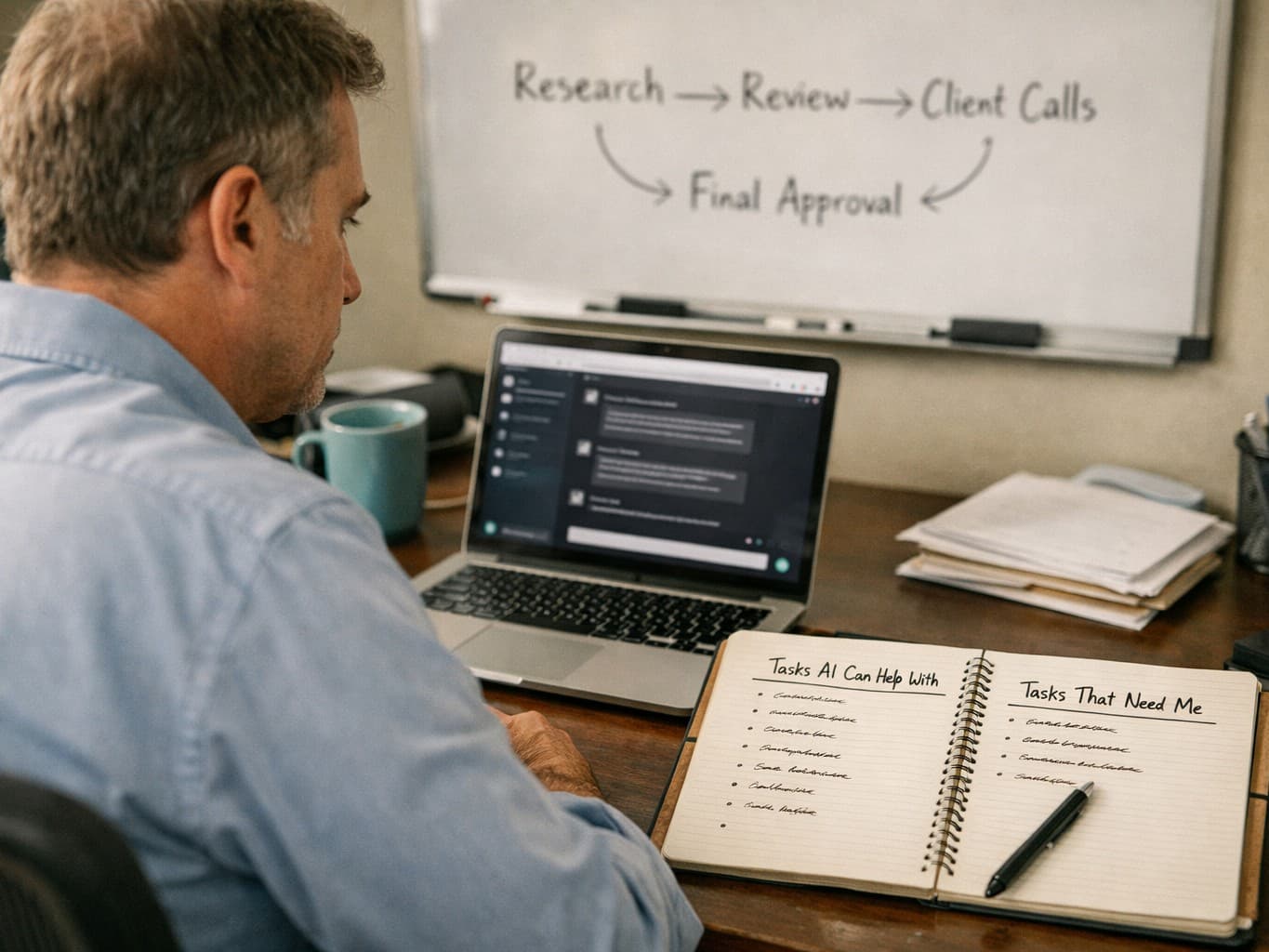
List your regular tasks for a normal month, then sort each one into one of four buckets:
Bucket 1: AI can probably do most of this now
These are tasks where current tools already produce acceptable results with little oversight. Examples might include meeting summaries, routine drafts, basic data cleanup, standard internal documentation, or common customer replies.
Bucket 2: AI can help a lot, but still needs you
These are tasks where AI can speed up the process but not own the result. Think analysis with context, editing for accuracy, research synthesis, stakeholder communication, or work that depends on proprietary information.
Bucket 3: AI is weak here unless your workplace changes dramatically
These tasks may require negotiation, relationship management, field work, leadership, hiring, coaching, or decisions under uncertainty.
Bucket 4: AI is not the main threat, but process redesign is
Some tasks are not directly replaceable by AI, but they could disappear if the surrounding workflow changes. For example, if AI reduces the need for meetings, someone may do less scheduling. If AI handles more self-service support, fewer people may triage tickets.
Now estimate how much of your week sits in each bucket. You do not need exact percentages. A rough picture is enough.
If a large share of your job sits in Bucket 1, your role is exposed. If most of your value sits in Buckets 2 and 3, you are likely looking at job redesign more than immediate replacement. If Bucket 4 is large, watch organizational changes, not just the tools.
Titles that sound safe can still be vulnerable
It is easy to assume creative, technical, or knowledge jobs are protected because they look skilled from the outside. That is not always how employers think.
An employer does not need AI to do your whole job better than you. They only need AI to reduce the labor required enough to rethink headcount, hiring plans, outsourcing, or who gets promoted.
That means even strong workers can feel pressure if they spend too much time on the most automatable layer of their role.
A graphic designer who mainly produces quick-format variations from existing brand rules may face more pressure than a designer who leads brand systems, works with stakeholders, and makes judgment-heavy decisions. A junior analyst who mostly compiles reports may face more pressure than an analyst who frames the right business questions and explains tradeoffs clearly to leadership.
This is why generic advice like "learn to prompt" is not enough. Prompting is a tool, not a moat. Your advantage comes from owning parts of the workflow that require interpretation, trust, domain context, and responsibility.
How employers usually adopt AI in the real world
The dramatic version of the story is full replacement. In practice, many organizations move in stages.
Stage 1: Optional experimentation
A few people use AI informally to save time on drafts, summaries, note-taking, or brainstorming.
Stage 2: Standardized use for narrow tasks
Management notices productivity gains and starts encouraging or requiring AI for certain workflows.
Stage 3: Process redesign
Templates, approvals, staffing expectations, and turnaround times change. Teams may shrink through attrition rather than immediate layoffs.
Stage 4: Role consolidation
The organization decides fewer people are needed for the same output, or shifts hiring toward workers who can manage AI-assisted workflows.
This timeline matters because many people wait for a dramatic public signal. By the time a company announces cuts, the quieter changes often happened earlier: fewer openings, higher output expectations, narrower entry-level roles, and more pressure on workers whose value was tied to first-pass production.
If you work in a small business, this can play out differently but just as quickly. The owner may not think in terms of “AI strategy,” yet still replace manual steps one by one. For that angle, How to Build an AI Workflow for Small Business shows how businesses actually start integrating these tools.
Signs your role may be at growing risk
No single sign proves your job is in danger, but a cluster of them is worth taking seriously.
Your output is increasingly treated as a draft
If management starts viewing your main deliverables as something software can produce first and humans can check later, your role may be moving down the value chain.
Hiring shifts toward fewer juniors and more overseers
Many AI tools are strongest at entry-level production tasks. If fewer people are being trained on those tasks, career ladders can narrow.
Productivity targets rise without more support
When teams are expected to do significantly more with the same headcount because “the tools are better now,” AI is already changing labor demand.
Leadership talks more about efficiency than quality
If executive language centers on throughput, cost savings, and faster turnaround for work that used to justify more human time, that is a warning.
More of your work becomes template-driven
The more your work is broken into standard formats, required structures, and repeatable outputs, the easier it becomes to automate or reduce.
What to do if your job is exposed
Panic is not a strategy. Denial is worse. The practical move is to shift where your value sits.
Move closer to problem definition
People who receive tasks are usually more exposed than people who define them. Learn how requests are shaped, what success actually means, and which tradeoffs matter.
Own the last 20 percent
AI often gets you a fast first 80 percent. The remaining 20 percent may include verification, tailoring, prioritization, compliance, persuasion, and delivery. That layer is where trust accumulates.
Build domain depth
General AI skills are useful, but domain-specific judgment is more defensible. Become the person who understands the customer, regulation, workflow, or business constraint better than anyone else on the team.
Get good at oversight, not just production
Someone needs to evaluate outputs, catch subtle errors, compare options, and know when the model is confidently wrong. Those are not glamorous skills, but they are economically important.
Strengthen communication and coordination
As production gets cheaper, interpretation and alignment often matter more. Workers who can explain, translate, negotiate, and make decisions legible tend to remain useful.
Learn the adjacent systems around your task
If your current work is highly automatable, become useful one step upstream or downstream. A person who only drafts content may be exposed. A person who ties content to brand, legal review, distribution, measurement, and customer feedback is harder to cut.
If you’re early in your career, the risk is different
Entry-level workers have a particular problem. Many companies use junior roles for the exact kinds of tasks AI can now assist with: first drafts, basic analysis, routine support, and administrative handling.
That does not mean junior careers are over. It means the old apprenticeship model may get thinner in some fields. You may need to be more intentional about getting exposure to decision-making, client context, and review processes instead of staying in pure production for too long.
Try to learn:
- how senior people scope work
- how they judge quality
- how they handle edge cases
- how they communicate uncertainty
- how business decisions get made around your output
Those are the layers AI does not teach you automatically.
If you’re considering a career move
If AI pressure is making you question your path, avoid binary thinking. You do not have to choose between “stay forever” and “quit immediately.” Sometimes the best move is to build runway while you test adjacent options, side income, or retraining.
If that is where you are, How Much to Save Before Quitting a Job to Freelance can help you think through the financial side before making a jump based on fear.
A useful question is not just “Which jobs are safe?” but “Which jobs combine human judgment, responsibility, and a work setting that is hard to standardize?” Safety usually comes from combinations of skills and context, not from chasing a supposedly untouchable title.
The better question than “Is my job safe?”
The safest mindset is not to look for reassurance that your role will stay unchanged. It is to ask how your role is likely to change, which tasks are becoming cheaper, and where human value is moving.
For most people, the answer will be mixed. Parts of your work may get easier. Parts may get commoditized. New expectations may appear before obvious job losses do. Some workers will benefit because they adapt faster. Others will be squeezed because they mistake current employment for long-term protection.
So is your job safe from AI? Probably not in the absolute sense. But if you can identify which parts of your work are exposed, strengthen the parts that require judgment and trust, and learn to use AI as leverage rather than as a substitute for thinking, you put yourself in a much better position than someone waiting for certainty.
That is the real goal: not finding a perfectly safe job, but becoming harder to replace in a world where more routine work is up for grabs.