Signs You Need a Rest Day, Not a Workout
Learn how to tell when your body needs recovery instead of another workout, and what to do on a true rest day.
Deelo Editorial

Pushing through fatigue is not always discipline. Sometimes the smarter move is to skip the workout, recover, and come back stronger the next day.
The hard part is telling the difference between ordinary reluctance and a real need for rest. If your body feels unusually run-down, your performance has dropped for several sessions in a row, or normal soreness has turned into lingering pain, a rest day is often the better call.
A lot of people struggle with this because fitness advice often rewards consistency, and consistency gets misread as never backing off. But training only works if recovery is built into it. Muscles repair between sessions, not during them. Your nervous system, connective tissue, sleep quality, and motivation all matter too.
That is especially true if you are trying to build a habit that lasts. Sustainable exercise is not a streak of perfect workouts. It is a pattern you can maintain without digging yourself into exhaustion. If you are new to training, or returning after time off, this matters even more. Our guide to Strength Training for Beginners Over 40: A Simple Plan covers this well: progress usually comes faster when you respect recovery instead of treating it as lost time.
What a rest day actually means
A rest day does not always mean doing nothing. It means reducing stress enough for recovery to happen.
For one person, that may mean a full day off from intentional exercise. For another, it may mean replacing a hard workout with a walk, light mobility work, easy stretching, or routine daily movement. The key question is not whether you moved. It is whether the day helped you recover.
This distinction matters because many people turn “active recovery” into another workout. If your easy day leaves you more tired than when you started, it probably was not recovery.
In broad terms, you are more likely to need rest when:
- fatigue is deeper than usual
- soreness is lasting longer than normal
- your sleep, mood, or focus are slipping
- performance is trending down without an obvious reason
- minor aches are becoming sharper or more localized
- the idea of training feels physically draining, not just inconvenient
One off day is not a crisis. In many cases, it is part of the process.
The most common signs you need a rest day, not a workout
1. Your soreness is not normal post-workout soreness
Mild to moderate soreness after a new or hard session can be completely normal. It usually improves within a couple of days and feels diffuse rather than sharp.
A rest day is more appropriate when soreness is:
- still intense after several days
- getting worse instead of better
- affecting how you walk, squat, lift, or reach
- paired with swelling, joint irritation, or a sense that something is “off”
If the discomfort feels sharp, one-sided, unstable, or concentrated around a joint rather than a muscle, that moves out of ordinary recovery and closer to possible injury. That is not a sign to train harder through it.
2. Your performance has clearly dipped for more than a day
Bad workouts happen. One sluggish run or weak lifting session does not necessarily mean anything.
But if you have had several workouts in a row where weights feel unusually heavy, your pace is harder to maintain, your coordination feels off, or your usual effort level suddenly feels much tougher, your body may be asking for recovery.
This matters because performance often drops before motivation catches up. People sometimes interpret that dip as laziness and respond by pushing harder. In reality, a short break may be exactly what lets performance rebound.
3. Your resting energy feels low all day
General tiredness can come from many things: poor sleep, life stress, not eating enough, dehydration, illness, or heavy training. You do not need to diagnose the precise cause on the spot to make a smart decision.
If you feel drained from morning to night, and especially if your limbs feel heavy or your body feels unusually flat, a hard workout may do more harm than good. Training creates stress. If your system is already overloaded, adding more is not always productive.
4. Your sleep has been worse than usual
Recovery and sleep are tightly linked. Hard training can affect sleep, and poor sleep can make training feel much harder.
If you have had multiple nights of broken sleep, very short sleep, or sleep that leaves you feeling unrefreshed, it may make sense to scale back. Coordination, reaction time, mood, and perceived effort all tend to suffer when sleep is off. Even if you can force the session, it may not be high-quality work.
5. Your mood is off and your patience is thin
Physical fatigue does not always show up as obvious muscle soreness. Sometimes it shows up as irritability, low motivation, unusual anxiety, or a sense that everything feels harder than it should.
That does not mean every bad mood requires a day off. Exercise can help mood. But if your emotional state has shifted alongside declining performance, poor sleep, or heavy fatigue, it may be part of a larger recovery problem.
6. Your heart rate or effort feels unusually high for easy work
You do not need fancy tech to notice this. If an easy workout suddenly feels hard, if your breathing gets labored earlier than usual, or if your warm-up feels like the main session, listen to that signal.
Many exercisers notice that on under-recovered days, normal movement feels strangely expensive. Stairs feel harder. Easy paces are not easy. The body often tells you before a tracking app does.
7. You are getting sick, or you feel like you might be
If you are coming down with something, rest is often the smarter move. A hard workout can feel surprisingly manageable in the moment and leave you feeling worse later.
General rule: if you feel genuinely ill, fatigued, feverish, achy in a whole-body way, or your symptoms are moving beyond a mild head cold, default toward rest. If symptoms are severe or you are unsure, medical advice is more useful than generic fitness rules.
8. Small aches are turning into real pain
A nagging hot spot in the shin, shoulder, knee, low back, or foot is worth paying attention to. Overuse issues rarely improve because you ignored them better.
One reason people miss this sign is that the pain may start small and only appear during warm-up, stairs, certain lifts, or the next morning. If a specific movement keeps provoking the same pain, that is a sign to stop loading it the same way until you understand what is happening.
9. You dread the workout in a physical way
Not every lack of motivation means overtraining or poor recovery. Sometimes you are just not in the mood, and a short workout still helps.
But there is a difference between “I do not feel like it” and “my whole system feels resistant.” If the thought of training comes with heaviness, unusual fatigue, brain fog, or the sense that you are scraping the bottom of the barrel, take that seriously.
Learning this difference is part of building a habit that sticks. The goal is not to obey every passing feeling. The goal is to get better at reading useful signals.
Rest day or excuse? How to tell the difference
This is where most people get stuck.
If you skip workouts often, it is easy to worry that any desire to rest is just avoidance. If you are very disciplined, it is easy to assume every warning sign is weakness. Neither extreme is helpful.
A practical way to sort it out is to look for patterns instead of relying on one emotion in one moment.
You may just need help getting started when:
- you are mentally resistant but physically fine once you begin
- your recent sleep, soreness, and energy have been normal
- your body feels better during the warm-up, not worse
- you have no unusual pain or lingering fatigue
You may need a rest day when:
- your warm-up feels harder than normal
- fatigue has been building for days
- several recovery signals are off at once
- your body feels worse as the session starts
- you are compensating around pain
A simple check-in can help:
- How did I sleep?
- How sore am I, and where?
- Do I have energy, or am I running on fumes?
- Is anything painful, not just stiff?
- Have my last few workouts felt worse than expected?
If multiple answers point in the same direction, believe the pattern.
What to do instead of a workout
If you decide you need a rest day, the next question is usually what to do with it.
The answer is simple: choose the option that supports recovery, not the option that lets you feel like you still “did enough.”
That might be:
- a full day off from training
- an easy walk
- light mobility or stretching
- gentle cycling or swimming at a conversational effort
- extra sleep
- eating regular meals and hydrating well
- reducing other stress where possible
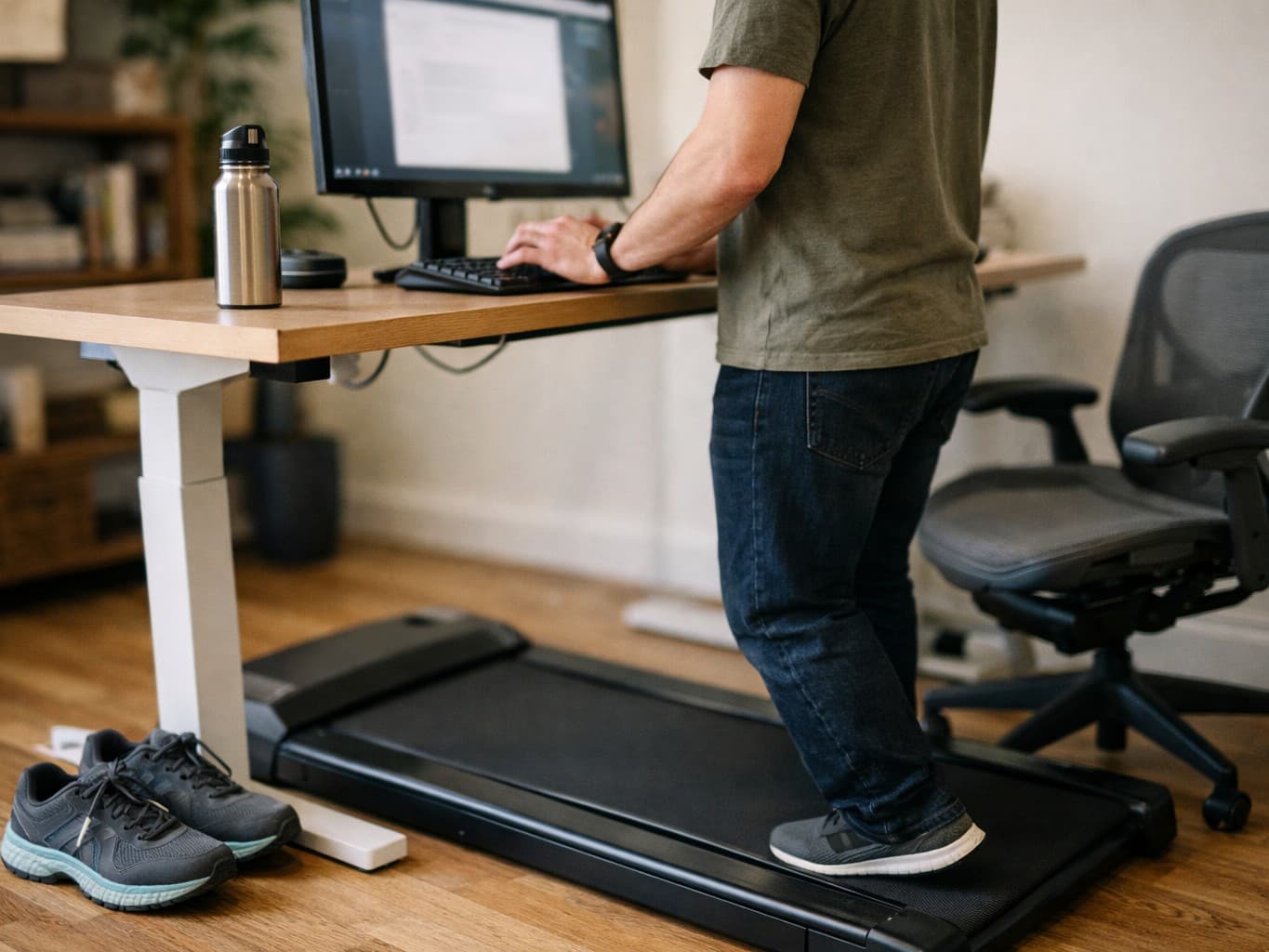
For many people, walking is a good middle ground because it preserves routine without adding much training stress. If you want movement that feels manageable on lower-energy days, Walking Pad Desk Setup for Beginners: A Practical Guide offers a realistic look at how light walking can fit into everyday life without turning recovery into another demanding session.
What usually does not help is replacing your hard workout with a “lighter” version that still ends up intense. If you need rest, give yourself rest.
How to prevent needing emergency rest days all the time
An occasional unscheduled rest day is normal. Needing one constantly is often a sign that your training plan, recovery habits, or overall life load need adjustment.
Build recovery into the program
Do not wait until your body forces the issue. Plan easier days, lower-intensity sessions, and full rest days ahead of time. Most people do better with a rhythm that includes variation instead of trying to hit the same intensity every day.
Progress slower than your enthusiasm wants to
A common mistake is increasing volume, intensity, and frequency at the same time. That feels productive right up until it does not.
If you are building a habit, leave room to adapt. Doing a little less than your maximum sustainable amount is often what keeps you consistent.
Eat enough to support training
Under-fueling can look a lot like poor motivation or overtraining: low energy, irritability, flat workouts, and prolonged soreness. You do not need a perfect nutrition plan to notice the basics. If you are training regularly, skipping meals and expecting your body to perform anyway tends to catch up with you.
Protect sleep as part of training
People often think of sleep as a separate health topic. It is training support. If sleep is repeatedly poor, your recovery ceiling drops.
Pay attention to life stress
Your body does not divide stress into neat categories. Hard training, work pressure, parenting, travel, poor sleep, and illness all draw from the same basic recovery capacity.
This is one reason habit-building advice matters so much. A good routine is not just ambitious. It is adjustable. That idea also shows up outside fitness in our guide to How to Use AI Without Losing Critical Thinking: systems work better when you stay engaged and make judgments instead of following rules blindly. Training is similar. A plan helps, but you still need to interpret what is happening.
When a rest day is not enough
Sometimes the right answer is not one day off. It is a longer reset, a lighter training week, or medical attention.
Take a bigger step back if:
- pain is persistent or worsening
- fatigue is lasting beyond a few easier days
- your performance keeps sliding despite rest
- sleep and mood remain off
- you suspect illness or injury
If something feels wrong in a way that seems bigger than normal exercise fatigue, get it checked. Advice from the internet is useful only up to that point.
The habit-building takeaway
The people who stay active long term are not usually the ones who never miss a workout. They are the ones who know when to push, when to modify, and when to stop for a day.
That is what makes rest part of consistency rather than the opposite of it. A well-timed rest day protects your next week of training, your motivation, and your odds of avoiding injury.
If you are wondering whether taking today off will derail your progress, it probably will not. Ignoring repeated signs that you need recovery is more likely to do that.
So if your body is giving you multiple clear signals — unusual fatigue, declining performance, poor sleep, lingering soreness, or pain — take the day. The workout you skip today may be what allows you to keep showing up next month.